

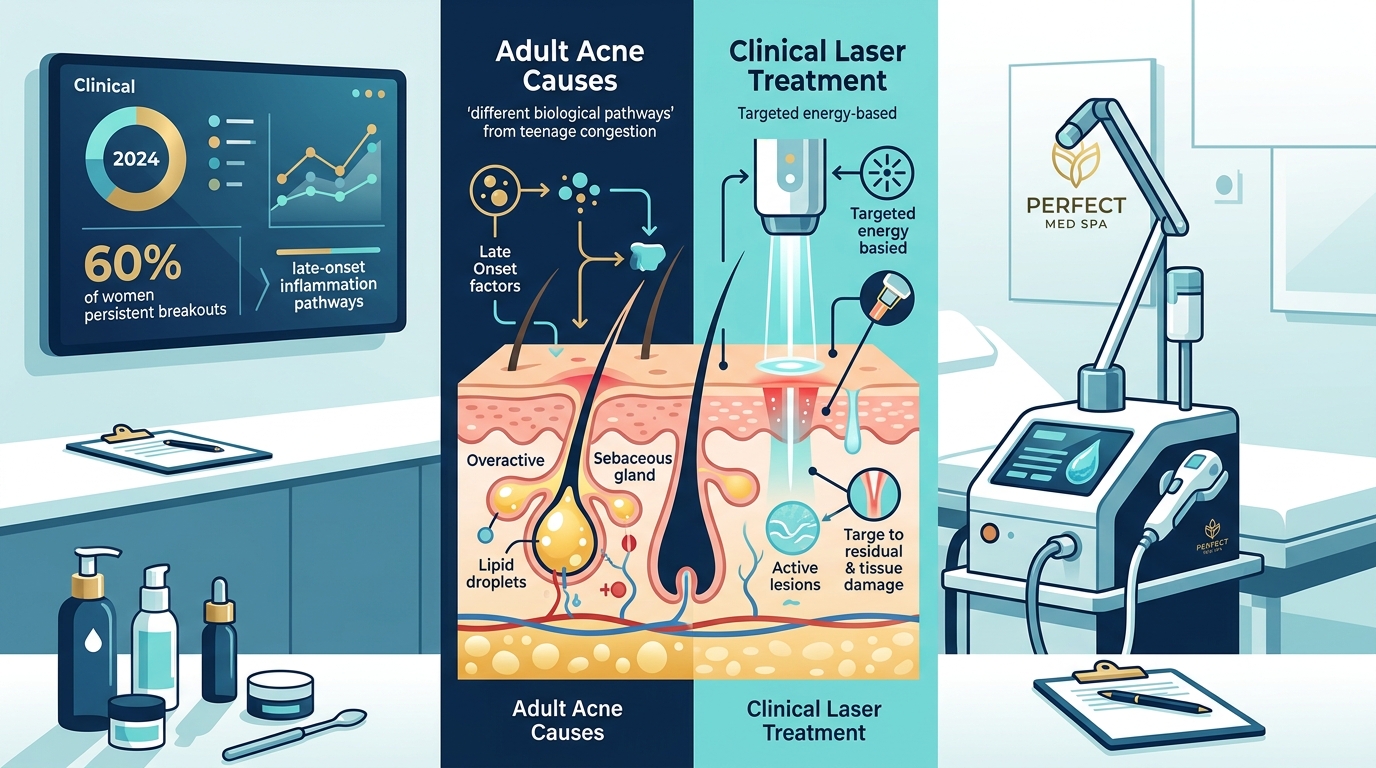
Recent clinical data from 2024 shows that approximately sixty percent of women experience persistent breakouts after their twentieth birthday. clinical data proves that late-onset skin inflammation operates through entirely different biological pathways than teenage congestion. Understanding these underlying mechanisms allows patients to bypass ineffective over-the-counter routines and transition directly toward targeted clinical interventions. Modern dermatology now offers precise energy-based devices that address both active lesions and residual tissue damage. This guide examines the physiological triggers behind persistent breakouts and evaluates the most effective professional laser treatments to clear it safely.
The Biological Drivers of Late-Onset Breakouts
Adult acne is a chronic inflammatory condition characterized by persistent comedones and papules that emerge after the age of twenty-five. Unlike adolescent congestion, which typically stems from sudden puberty-driven sebum surges, late-onset breakouts operate through complex cellular turnover disruptions. The outer skin layer often fails to shed dead cells efficiently, creating a physical barrier that traps bacteria and oil. This structural bottleneck forces the immune system to mount a sustained inflammatory response. Patients frequently notice these lesions along the jawline and lower cheeks, which directly correlates with deeper hormonal signaling. Our specialists at Perfect Med Spa utilize advanced diagnostic mapping to identify these exact triggers before initiating any energy-based protocol.
Environmental stressors and lifestyle factors compound this cellular stagnation. Chronic sleep deprivation elevates cortisol levels, which directly stimulates sebaceous glands to produce thicker, more viscous oil. This altered sebum composition adheres more aggressively to follicular walls, making natural shedding nearly impossible. When combined with heavy cosmetic formulations, the resulting micro-comedones rapidly progress into inflamed papules. Recognizing these compounding variables allows clinicians to select the appropriate wavelength and energy density for each unique skin type.
Hormonal Fluctuations and Stress Responses
Hormonal acne is a specific subtype of persistent breakouts driven by androgen sensitivity and cyclical progesterone shifts. These chemical messengers directly instruct oil glands to enlarge and produce excess sebum. Many patients report predictable flare-ups occurring one week before menstruation or during periods of intense professional pressure. This cyclical pattern requires a treatment strategy that addresses both the active inflammation and the underlying glandular hyperactivity. Energy-based therapies now offer a non-systemic alternative to oral medications, delivering targeted thermal energy directly to the affected follicles. This precise approach shrinks overactive sebaceous glands without disrupting the rest of the endocrine system. You can explore our comprehensive clinical blog to review detailed case studies on hormonal skin management.
Stress-induced breakouts follow a distinct biochemical pathway that differs from standard bacterial acne. When the body perceives chronic psychological strain, it releases neuropeptides that directly stimulate inflammatory pathways. These chemical signals increase vascular permeability, causing existing micro-comedones to swell rapidly. The resulting lesions often appear as deep, tender nodules that resist topical creams. Addressing this specific subtype requires modalities that combine targeted thermal disruption with gentle lymphatic drainage. Our Long Island and New York City locations utilize calibrated radiofrequency devices to safely reduce glandular volume while preserving surrounding tissue integrity.
How Professional Laser Therapies Target Active Lesions
Professional laser acne treatment utilizes specific light wavelengths to penetrate the epidermis and target porphyrins within Propionibacterium acnes bacteria. When these light-activated compounds absorb the energy, they generate localized oxidative stress that destroys the bacterial colonies without damaging healthy tissue. This precise mechanism halts the inflammatory cascade at its source. Modern devices now combine multiple wavelengths to address both active lesions and residual hyperpigmentation in a single session. Clinicians carefully calibrate pulse durations to match individual skin phototypes, ensuring maximum efficacy with minimal downtime. Patients typically report visible lesion reduction after just three to four scheduled appointments. Our team prioritizes acne scar removal protocols that seamlessly integrate active breakout management with long-term texture correction.
Non-ablative fractional lasers represent a significant advancement in treating persistent congestion. These devices create microscopic columns of thermal injury that stimulate rapid cellular turnover and collagen remodeling. The resulting micro-channels allow topical serums to penetrate deeply, amplifying the effects of medical-grade topical agents. This dual-action approach accelerates the resolution of stubborn papules while simultaneously smoothing surface irregularities. Recovery typically involves mild redness that resolves within forty-eight hours. Most patients return to their daily routines immediately following treatment. We recommend scheduling these sessions during periods of lower social obligation to optimize comfort and compliance.
Comparing Clinical Modalities for Lasting Results
Selecting the optimal energy-based protocol requires a careful evaluation of lesion depth, skin type, and historical treatment responses. The following table outlines the primary clinical options available at our facilities.
| Therapy Modality | Primary Mechanism | Best For | Typical Session Count |
|---|---|---|---|
| IPL Photofacial | Broad-spectrum light targets porphyrins and vascular networks | Superficial redness and active papules | 3 to 5 sessions |
| Morpheus8 | Radiofrequency energy delivered via microneedles | Deep nodular cysts and textural irregularities | 2 to 4 sessions |
| Blue Light Therapy | Specific wavelength destroys anaerobic bacteria | Widespread surface congestion | 4 to 6 sessions |
| Chemical Resurfacing | Controlled acid exfoliation accelerates turnover | Stubborn comedones and post-inflammatory marks | 3 to 4 sessions |
Each modality operates through distinct physical principles, yet all share the common goal of restoring follicular patency. Radiofrequency microneedling delivers heat directly to the dermal layer, effectively shrinking overactive oil glands while stimulating structural proteins. This makes it exceptionally effective for patients who experience deep, painful cystic formations. Broadband light therapies excel at addressing surface redness and superficial bacterial loads. Combining these approaches often yields superior long-term outcomes. Our clinicians design customized treatment matrices that rotate modalities based on your skin's evolving response. You can review our complete service directory at our dedicated skin technology page to understand the technical specifications of each device.
What to Expect During Your First Clinical Session
Preparing for your initial energy-based appointment requires strict adherence to pre-treatment guidelines. Clinicians typically instruct patients to discontinue retinoids and exfoliating acids five days prior to arrival. This precaution minimizes surface sensitivity and ensures optimal energy absorption. On the day of your procedure, you will undergo a thorough cleansing and photographic documentation process. The practitioner will then map your treatment zones, marking areas requiring higher energy density or extended pass coverage. During the actual procedure, you will feel a series of rapid, warm pulses accompanied by a distinct ozone-like scent. Most patients tolerate the experience comfortably with topical numbing agents applied beforehand. Post-procedure care involves gentle hydration and strict sun avoidance for fourteen days. Our staff provides detailed aftercare instructions to maximize your results and prevent post-inflammatory hyperpigmentation. Schedule a comprehensive evaluation at our contact page to begin your personalized treatment journey.
Key Takeaways
- Approximately sixty percent of adult women experience persistent breakouts after their twentieth birthday, according to 2024 dermatological surveys.
- Adult acne is a chronic inflammatory condition characterized by persistent comedones and papules that emerge after the age of twenty-five.
- Hormonal acne is a specific subtype of persistent breakouts driven by androgen sensitivity and cyclical progesterone shifts.
- Professional laser acne treatment utilizes specific light wavelengths to penetrate the epidermis and target porphyrins within acne bacteria.
- Radiofrequency microneedling delivers heat directly to the dermal layer, effectively shrinking overactive oil glands while stimulating structural proteins.
- Most patients report visible lesion reduction after just three to four scheduled appointments with calibrated energy devices.
- Strict pre-treatment preparation and post-procedure sun avoidance are mandatory for optimal clinical outcomes.
Frequently Asked Questions
Can laser treatments completely eliminate adult acne?
While no single procedure guarantees permanent eradication, consistent clinical sessions significantly reduce lesion frequency and severity. Most patients achieve long-term clearance when combining energy-based therapies with targeted topical regimens. Maintenance sessions every six to twelve months typically preserve these results indefinitely.
Is Morpheus8 safe for darker skin tones?
Yes, modern radiofrequency microneedling devices utilize shorter pulse durations and deeper penetration settings that bypass melanin absorption. This technical adjustment minimizes the risk of post-inflammatory hyperpigmentation while safely treating Fitzpatrick skin types four through six. Our clinicians perform thorough skin assessments before selecting appropriate energy parameters.
How many IPL sessions are required for active breakouts?
Most patients require between three and five broadband light sessions spaced three weeks apart. This frequency allows the skin to complete its natural repair cycle between treatments. Visible improvements typically emerge after the second appointment, with maximum clearance occurring after the final session.
Will laser therapy cause scarring or prolonged downtime?
Non-ablative energy devices are specifically engineered to avoid surface destruction, thereby eliminating traditional downtime. Patients may experience mild redness and slight swelling that resolves within forty-eight hours. Strict adherence to post-procedure hydration protocols ensures rapid recovery and optimal tissue remodeling.
Can I combine laser treatments with topical acne medications?
Clinicians typically pause prescription retinoids and benzoyl peroxide five days before and after each session. This temporary pause prevents excessive surface irritation while allowing the energy devices to work efficiently. Your provider will outline a precise reintroduction schedule to maintain long-term follicular health.
Schedule Your Personalized Consultation
Resolving persistent breakouts requires precise diagnostic mapping and calibrated energy delivery. Our board-certified practitioners at Perfect Med Spa utilize advanced diagnostic mapping to identify these exact triggers before initiating any energy-based protocol. We invite you to book a comprehensive skin analysis at our New York City or Long Island locations. Our specialists will design a customized treatment matrix that addresses your specific lesion depth, skin phototype, and historical treatment responses. Visit https://perfectmedspa.com/ to reserve your appointment and reclaim your skin confidence today.