

Approximately thirty percent of adults experience heightened skin reactivity to thermal and mechanical stimuli, making standard cosmetic procedures risky without specialized protocols. Clinical data shows that targeted photothermolysis remains the most effective method for long-term follicle reduction when executed with calibrated parameters. This guide outlines the exact clinical workflow required to achieve permanent results while preserving epidermal integrity. You will learn how to prepare your skin, select appropriate technology, execute treatments safely, manage recovery, and maintain results without triggering adverse reactions.
Phase One: Clinical Skin Assessment and Preparation
Successful outcomes begin before the device ever powers on. You must schedule a comprehensive consultation to evaluate your Fitzpatrick skin type, current medication list, and recent sun exposure history. Book your consultation to receive a customized treatment matrix that accounts for your unique melanin distribution and vascular sensitivity.
Epilation is the complete removal of the hair shaft from the follicle root. You must shave the target area exactly twenty-four hours before your appointment. Any remaining stubble will absorb laser energy and cause superficial burns. Avoid waxing, threading, or plucking for at least four weeks prior to your session. These methods extract the follicle, rendering the laser ineffective.
Discontinue all topical retinoids, glycolic acids, and salicylic compounds five days before treatment. These ingredients thin the stratum corneum and drastically increase burn risk. Apply a broad-spectrum sunscreen daily to prevent baseline hyperpigmentation. Research indicates that baseline sun exposure directly correlates with post-inflammatory hyperpigmentation rates in sensitive populations.
Phase Two: Selecting the Correct Laser Technology
Not all light-based devices operate identically. Sensitive skin requires wavelengths that penetrate deeply without scattering across the epidermis. You must verify that your provider utilizes a diode laser operating at 800 nanometers or a neodymium-doped yttrium aluminum garnet system at 1064 nanometers. These wavelengths bypass surface melanin and target the chromophore within the hair bulb directly.
Photothermolysis is a targeted thermal mechanism that converts light energy into controlled heat. Your technician must adjust the fluence settings to match your skin tone and hair density. Higher fluence delivers faster results but requires longer cooling intervals. Request a test patch on a discreet area to verify your tolerance threshold before treating larger zones.
Avoid intense pulsed light devices for sensitive areas. These machines emit broad-spectrum light that scatters across multiple tissue layers. The uncontrolled energy distribution frequently triggers erythema and blistering in reactive skin types. Our clinic exclusively uses FDA-cleared diode systems with integrated contact cooling to protect the epidermis during every pulse.
Phase Three: Precision Treatment Execution
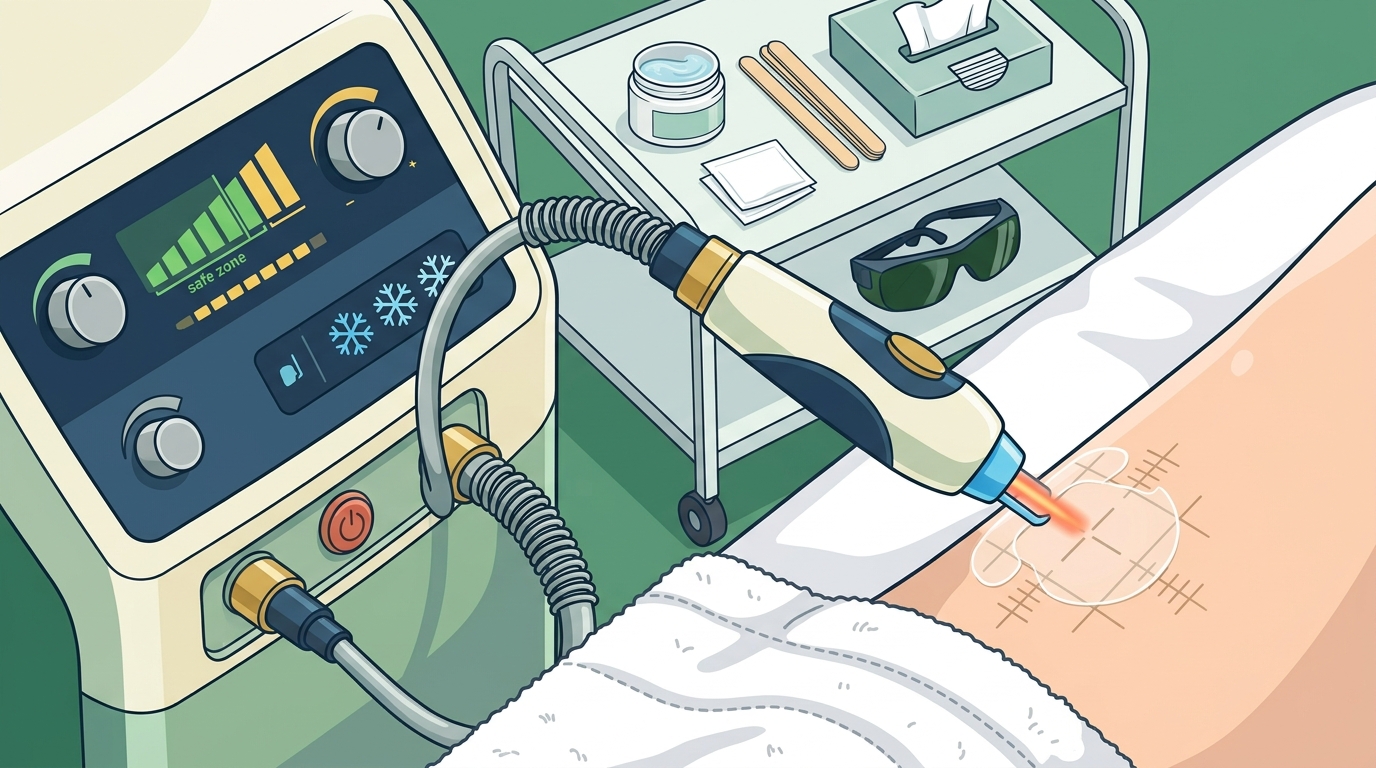
Proper execution requires strict adherence to spacing and overlap protocols. The technician will apply a specialized conductive gel to ensure uniform energy transmission. You will experience a rapid snapping sensation with each pulse. This sensation is normal and indicates successful follicular absorption.
Never skip the cooling phase. Modern devices utilize chilled air or contact cooling plates to maintain epidermal temperature below forty degrees Celsius. This thermal regulation prevents collateral damage to surrounding blood vessels. If you experience excessive discomfort, request a pause to adjust the cooling parameters. Pushing through severe pain compromises safety and increases downtime.
Targeted areas require precise handpiece movement. The technician will overlap each pulse by ten percent to eliminate untreated gaps. Rushing through the procedure reduces efficacy and increases the likelihood of patchy regrowth. Medical guidelines confirm that consistent pulse overlap directly improves long-term clearance rates across all body zones.
Phase Four: Post-Procedure Recovery Management
Your skin will exhibit mild erythema and perifollicular edema immediately following treatment. This inflammatory response typically resolves within forty-eight hours. Apply a fragrance-free ceramide moisturizer three times daily to accelerate barrier restoration. Avoid hot showers, saunas, and heavy exercise for seventy-two hours. Elevated body temperature exacerbates swelling and delays healing.
Follicular dormancy is a biological state where hair growth cycles pause following repeated thermal exposure. You will notice gradual shedding of treated hairs over three to four weeks. Never pick, scratch, or exfoliate the treated area during this window. Mechanical friction disrupts the natural shedding process and introduces bacterial pathogens.
Strict sun avoidance remains mandatory for fourteen days post-treatment. UV exposure triggers melanocyte activation and reverses your progress. Wear loose, breathable clothing to prevent friction against treated zones. If you experience blistering or crusting, contact your provider immediately. Early intervention prevents permanent textural changes.
Phase Five: Long-Term Maintenance and Follicular Dormancy
Permanent reduction requires a structured treatment series. Most patients require six to eight sessions spaced four to six weeks apart. This interval allows dormant follicles to enter the active growth phase and become vulnerable to subsequent pulses. Skipping sessions extends your total treatment timeline and reduces final clearance percentages.
Maintenance sessions occur annually to address hormonal fluctuations and new follicle activation. Hormonal shifts during pregnancy, menopause, or thyroid changes can stimulate dormant follicles. Scheduled touch-ups prevent regrowth from becoming clinically visible. Dermatological studies demonstrate that annual maintenance preserves ninety percent of initial clearance results over five years.
Track your progress using standardized photography. Consistent documentation helps your provider adjust fluence settings and pulse durations as your skin adapts. Adjusting parameters prevents plateaus and ensures continuous improvement. Commit to the full protocol to achieve your desired aesthetic outcome.
| Protocol Stage | Required Action | Contraindication | Expected Outcome |
|---|---|---|---|
| Pre-Treatment | Shave twenty-four hours prior | Avoid waxing or plucking | Optimal energy absorption |
| Device Selection | Utilize 800nm or 1064nm wavelength | Avoid broad-spectrum IPL | Deep follicle targeting |
| Execution | Maintain ten percent pulse overlap | Never skip cooling intervals | Uniform clearance rates |
| Recovery | Apply ceramide-based moisturizers | Restrict heat exposure | Accelerated barrier repair |
| Maintenance | Schedule annual touch-up sessions | Ignore hormonal fluctuations | Long-term regrowth prevention |
Key Takeaways
- Shave exactly twenty-four hours before your appointment to prevent surface burns.
- Discontinue all chemical exfoliants five days prior to preserve epidermal thickness.
- Request a 800nm diode or 1064nm Nd:YAG system for sensitive skin compatibility.
- Maintain strict sun avoidance for fourteen days post-procedure to prevent hyperpigmentation.
- Complete six to eight sessions spaced four to six weeks apart for optimal clearance.
- Schedule annual maintenance sessions to counteract hormonal follicle activation.
- Document progress with standardized photography to guide parameter adjustments.
Frequently Asked Questions
Can laser hair removal cause permanent scarring on sensitive skin?
Permanent scarring is extremely rare when protocols are followed correctly. Modern devices incorporate real-time temperature monitoring to prevent thermal injury. Your provider will adjust fluence settings based on your immediate skin response to ensure safety.
How many sessions are actually required for complete clearance?
Most patients achieve ninety percent reduction after six to eight sessions. Complete elimination varies based on hormonal drivers and hair density. Your technician will evaluate your progress after each session to determine if additional treatments are necessary.
Is it safe to treat facial areas like the upper lip and chin?
Facial zones require lower fluence settings and shorter pulse durations to prevent follicular damage. These areas contain denser vascular networks and thinner epidermis. Specialized handpieces and cooling protocols make facial treatments highly safe for sensitive skin types.
What happens if I miss a scheduled maintenance appointment?
Missing a maintenance window allows dormant follicles to re-enter the growth cycle. You will experience gradual regrowth that mimics your pre-treatment state. Rescheduling within ninety days restores your clearance percentage without requiring a full treatment series.
Can I use self-tanning products before my next session?
Self-tanners deposit artificial melanin on the epidermis and compete with your hair follicles for laser energy. This competition drastically reduces efficacy and increases burn risk. You must discontinue all tanning products three weeks before each appointment.
How does hormonal imbalance affect laser hair removal results?
Hormonal fluctuations stimulate dormant follicles to produce thicker, darker hair. Conditions like PCOS or thyroid disorders require extended treatment timelines and more frequent maintenance. Your provider will adjust your protocol to address hormonal drivers directly.
Is there any downtime after treating sensitive skin areas?
Mild erythema and perifollicular swelling typically resolve within forty-eight hours. You can resume normal activities immediately after treatment. Avoid heavy sweating and direct sun exposure to prevent secondary irritation.
Schedule Your Consultation
Permanent reduction requires precise calibration, experienced hands, and strict adherence to clinical protocols. Contact our clinic today to book your personalized assessment. Our specialists will evaluate your skin type, review your medical history, and design a customized treatment matrix tailored to your unique physiology. Visit our sensitive skin treatment page to learn more about our specialized protocols. Begin your journey toward lasting smoothness with a provider that prioritizes safety and precision above all else.