

Breakouts past 25 are not a leftover from puberty—they are a distinct condition with its own drivers and its own solutions. Below, we break down the five most overlooked triggers behind adult acne and match each one to the professional laser technology that addresses it at the source.
Adult Acne by the Numbers
Adult acne is far more prevalent than most people realize. According to Aurora Health Care, adult acne affects about 50 percent of women in their 20s and can persist into the 30s, 40s, and even 50s. Research from MDacne notes that hormonal acne affects nearly half of women in their 20s, and the Women’s Health Network reports that up to 40 percent of women over 30 develop late-stage acne. Overall, acne vulgaris is estimated to affect up to 50 million people annually in the United States alone.
5 Hidden Triggers Behind Adult Breakouts
Trigger 1: Micro-Hormonal Shifts You Cannot Feel
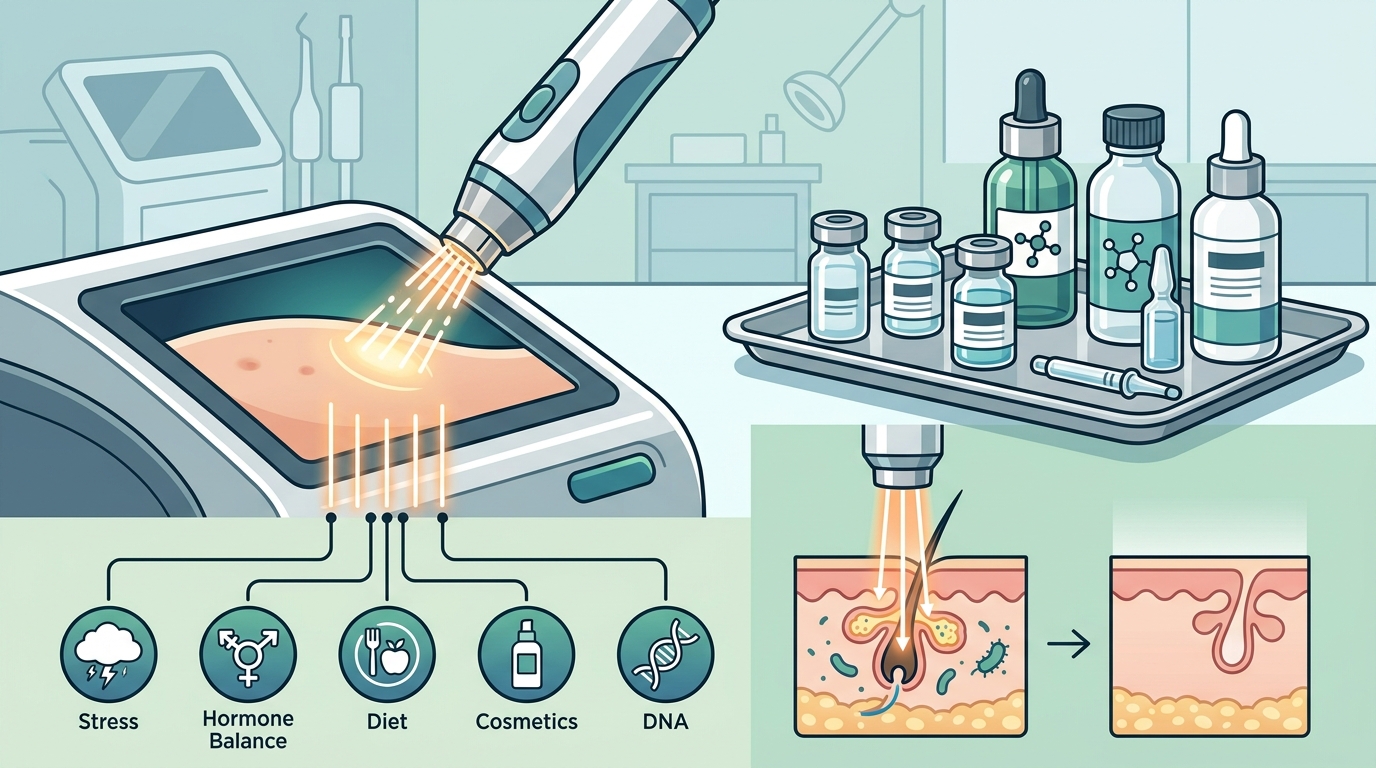
You do not need a dramatic hormonal event to break out. Subtle fluctuations in androgens can stimulate the sebaceous glands enough to clog pores. According to Cleveland Clinic, hormonal acne develops when hormonal changes increase the amount of oil your skin produces, and that oil interacts with bacteria inside the hair follicle. These shifts commonly coincide with menstruation, perimenopause, postpartum recovery, or switching birth control. Texas Health explains that coming off birth control often leads to a temporary “androgen rebound,” fueling more oil and clogged pores.
What makes adult hormonal acne uniquely frustrating is that blood tests may appear normal. As MDacne explains in its 2026 overview, skin cells can produce their own androgens, explaining why some individuals experience acne even when blood tests appear normal.
Trigger 2: Chronic Stress and Cortisol Overload
Stress does more than make you feel run-down. Chronic stress pushes the adrenal glands to overproduce cortisol, which directly stimulates sebum output. MDacne confirms that chronic stress prompts the adrenal glands to produce cortisol and adrenaline, both of which aggravate breakouts. Aurora Health Care adds that stress, a poor diet, and lack of sleep can also make hormonal acne worse.
Trigger 3: Genetic Sebaceous-Gland Sensitivity
Some people inherit oil glands that overreact to normal hormone levels. A peer-reviewed guide from PMC explains that adult female acne involves an increase in the number and sensitivity of the receptors located in sebocytes and keratinocytes to circulating androgenic hormones. Additionally, peripheral enzymatic activity can convert weaker hormones like DHEA-S into the far more potent DHT right inside the skin.
Trigger 4: PCOS and Metabolic Conditions
Polycystic ovary syndrome is one of the most common medical drivers of persistent adult acne. MDacne states that PCOS causes an overproduction of male hormones, which can lead to acne and other symptoms of hormonal imbalance. Cleveland Clinic lists PCOS alongside other ovarian and metabolic conditions as known risk factors.
Trigger 5: Skin-Barrier Disruption and Microbiome Imbalance
Over-washing, harsh actives, and environmental stressors strip the skin barrier and create a cycle of inflammation. The 2026 treatment landscape now recognizes adult acne as a multifactorial condition influenced by local hormone metabolism within the skin, microbiome imbalances, stress hormones like cortisol, and genetic sensitivity in oil glands. When the barrier is compromised, acne worsens regardless of what topicals you layer on.
Why Laser Technology Works When Topicals Stall
Topicals and oral medications remain valuable first-line tools, but they have limits. Retinoids cause dryness and irritation; antibiotics carry resistance risks; and isotretinoin demands months of monitoring. For patients who have plateaued on conventional therapy, laser treatments offer a non-pharmacologic path forward.
According to Dermatology Times, lasers provide a non-pharmacologic option that may reduce antibiotic reliance and help prevent long-term sequelae such as scarring and psychosocial distress. A 2025 review in the Journal of Clinical and Aesthetic Dermatology concluded that lasers have demonstrated efficacy as primary or adjunctive treatment modalities for acne vulgaris in certain clinical scenarios.
Laser-by-Laser Comparison Guide
| Laser / Device | Wavelength | Primary Target | Best For | Typical Sessions | Downtime |
|---|---|---|---|---|---|
| AviClear | 1726 nm | Sebaceous glands | Mild-to-severe active acne | 3 sessions, 4 weeks apart | Minimal (redness 1–2 days) |
| Accure | 1726 nm | Sebaceous glands (with real-time thermal monitoring) | Active inflammatory acne | 3 sessions, 4 weeks apart | Minimal |
| Nd:YAG (long-pulsed) | 1064 nm | Deep vasculature, inflammation | Inflammatory acne, redness | 4–6 sessions | None to minimal |
| Pulsed Dye Laser (PDL / Vbeam) | 595 nm | Hemoglobin in blood vessels | Red/inflamed acne, post-acne redness | 4+ sessions | Mild bruising 3–5 days |
| Fractional CO2 | 10,600 nm | Water in tissue (ablative) | Deep acne scars, texture | 1–2 sessions | 7–14 days |
| Fraxel Dual | 1550 / 1927 nm | Water in tissue (non-ablative + thulium) | Mild-to-moderate scars, pigmentation | 3–5 sessions | 3–5 days |
| Fractional Erbium | 2940 nm | Water in tissue (ablative, less thermal) | Boxcar and rolling scars | 2–4 sessions | 5–7 days |
| IPL (Intense Pulsed Light) | Broad spectrum | Porphyrins, melanin, hemoglobin | Mild acne, maintenance, redness | 4–6 sessions | None |
Spotlight: 1726 nm Sebum-Targeting Lasers (AviClear & Accure)
These represent the newest class of FDA-cleared devices designed specifically for acne rather than scarring. Dermatology Times describes them as sebum-specific wavelengths that penetrate deep enough to cause thermal damage to the pilosebaceous unit without heating surrounding skin. AviClear was the first device cleared by the FDA for mild-to-severe acne. Both AviClear and Accure received 501(k) clearance and are listed in the FDA database.
Spotlight: Fractional CO2 for Post-Acne Scarring
Once active breakouts are controlled, scarring often remains. Fractional CO2 lasers create microscopic channels that stimulate collagen production from the bottom up. Studies show that fractional CO2 lasers achieve approximately 75 percent improvement in acne scars. Expect one to two weeks of downtime, but the payoff is significant textural correction that topical products simply cannot replicate.
Spotlight: Combination Protocols
Modern evidence supports combining lasers with other modalities. Dermatology Times reports that combining laser treatments with isotretinoin may accelerate lesion clearance and improve scarring without increasing adverse effects, challenging long-held concerns about pairing these approaches.
How to Choose the Right Treatment at a Med Spa
- Get your acne typed first. Inflammatory papules, cystic nodules, comedonal bumps, and post-inflammatory scarring each respond to different wavelengths. A board-certified provider should classify your acne before recommending a device.
- Consider your skin tone. Lasers like Nd:YAG and 1726 nm devices are generally safer for darker skin tones, while ablative CO2 requires extra caution to avoid post-inflammatory hyperpigmentation.
- Map out a realistic timeline. Most laser protocols require three to six sessions spaced four to six weeks apart, plus healing time between visits.
- Ask about combination strategies. The best outcomes frequently come from pairing an active-acne laser (like AviClear) with a scar-revision laser (like Fraxel) once breakouts stabilize.
- Verify credentials. At Perfect Med Spa, treatments are performed under medical oversight to ensure proper device settings, safety protocols, and follow-up care tailored to your skin.
Key Takeaways
- Adult acne is driven by hormonal micro-shifts, cortisol, genetics, conditions like PCOS, and barrier disruption—often simultaneously.
- Blood tests can miss the problem because skin cells manufacture their own androgens locally.
- FDA-cleared 1726 nm lasers (AviClear, Accure) are the first devices approved to treat active acne by selectively damaging sebaceous glands.
- Fractional CO2 and Fraxel lasers address the scarring that persists after breakouts resolve, with studies showing up to 75 percent scar improvement.
- Combination protocols—pairing active-acne lasers with scar-revision devices—deliver the most comprehensive results.
- Professional assessment of acne type, skin tone, and severity is essential before selecting any laser modality.
Frequently Asked Questions
What causes acne in adults over 30?
Adult acne is primarily driven by hormonal fluctuations—especially androgen surges that increase sebum production. Chronic stress, genetic sebaceous-gland sensitivity, PCOS, and skin-barrier disruption are also major contributors. Up to 40 percent of women over 30 are affected.
Is laser treatment effective for active acne, not just scars?
Yes. Newer 1726 nm lasers like AviClear and Accure are FDA-cleared specifically for mild-to-severe active acne. They work by selectively targeting sebaceous glands to reduce oil production at the source. Nd:YAG and pulsed dye lasers also reduce active inflammation.
How many laser sessions does adult acne typically require?
For sebum-targeting lasers (AviClear, Accure), the standard protocol is three sessions spaced four weeks apart. Scar-focused lasers like fractional CO2 may need one to two aggressive sessions, while gentler non-ablative devices typically require three to five treatments.
Can laser acne treatment be combined with medications like isotretinoin?
Recent evidence suggests yes. Studies indicate that combining lasers with isotretinoin may accelerate clearance and improve scarring without increasing side effects. However, this should only be done under direct medical supervision.
Are acne lasers safe for darker skin tones?
Certain lasers are safer for skin of color than others. The 1726 nm and 1064 nm Nd:YAG wavelengths carry lower risk of post-inflammatory hyperpigmentation compared to ablative devices. A board-certified provider should evaluate your Fitzpatrick skin type before treatment.
How much do professional laser acne treatments cost?
Costs vary widely by device, location, and number of sessions. Sebum-targeting lasers like AviClear can cost thousands of dollars per session and are generally not covered by insurance. A consultation at Perfect Med Spa can give you an accurate estimate based on your treatment plan.